

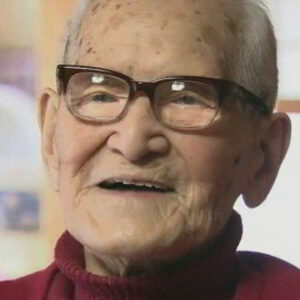
Jiroemon Kimura was a Japanese supercentenarian who became the oldest verified living man in December 2012. He lived to the age of 116 years and 54 days, making him the first and only man whose attainment of 116 years of age has been conclusively verified. Born in 1897, Kimura lived through the reigns of four Japanese emperors and witnessed the administrations of 61 prime ministers. During his lifetime, he experienced Japan’s expansion into militarism, its devastating wartime period, and its subsequent transformation into one of the world’s leading economic powers. Kimura was born and raised in a fishing village in Japan alongside his five siblings. After completing his education, he began working for the postal service, where he remained until retiring at the age of 65. In addition to his postal career, he engaged in farming. His remarkable longevity attracted considerable public attention, and he reportedly attributed his long life to habits such as waking up early and eating moderate portions of food. On June 12, 2013, Kimura died at a medical facility in his hometown of Kyōtango, Japan, at the age of 116. He was recognized as the last verified man born in the nineteenth century, leaving behind an extraordinary record of longevity and a life that spanned more than eleven decades of Japanese history.
Childhood & Early Life
Jiroemon Kimura was born Kinjiro Miyake in the fishing village of Kamiukawa, Japan, to Fusa and Morizo Miyake. He was one of their six children. Official records list his birth date as April 19, 1897. However, his nephew, Tamotsu Miyake, claimed that Kimura was actually born on March 19 of that year, creating a discrepancy regarding his exact birth date.
Career of Jiroemon Kimura
After completing his education, Kimura began working at local post offices when he was approximately 17 years old. During the 1920s, he also served as a government communications employee in Korea, which was then under Japanese colonial rule. He continued his postal service career until retiring at the age of 65.
Following his retirement, Kimura turned to farming and remained active in agricultural work for several decades. He continued working in the fields until he was around 90 years old, demonstrating an unusually long period of physical activity.
Family & Personal Life
As a young man, Kimura married Yae Kimura (1904–1978), a woman who lived in his neighborhood. Since her family had no male heir, he adopted her family name and took the name Jiroemon Kimura. The couple had seven children, 14 grandchildren, and 25 great-grandchildren.
Longevity was also evident among his siblings. Four of them reportedly lived beyond the age of 90, while his youngest brother reached the age of 100.
During his later years, Kimura lived in Kyōtango, in Kyoto Prefecture, in a two-story wooden house that he had built during the 1960s. His eldest son’s widow and his grandson’s widow helped care for him until his death. He enjoyed reading newspapers, welcoming visitors, and watching parliamentary discussions and sumo wrestling matches on television.
Kimura received numerous messages and greetings from well-wishers on his 116th and final birthday. Among them was a video message from Japan’s then-prime minister, Shinzō Abe, acknowledging his extraordinary longevity.
Death of Jiroemon Kimura
Kimura reportedly remained free from any major illness for most of his life. However, his health began to decline during the final months of 2013, and he became bedridden in February of that year. On May 11, 2013, he was admitted to a hospital with pneumonia.
He died at 2:08 a.m. on June 12, 2013, at a medical facility in Kyōtango, Japan. He was 116 years old, and his death was attributed to natural causes. His funeral took place on June 14, 2013.
Other Records & Achievements
Kimura achieved several significant longevity milestones during the final years of his life. On June 19, 2009, following the death of Tomoji Tanabe, he became Japan’s oldest living man. On April 15, 2011, he became the world’s oldest living man after Walter Breuning died.
Later that year, on December 2, 2011, Kimura became the oldest living person in Japan following the death of Chiyono Hasegawa. On December 17, 2012, after Dina Manfredini died, he became the world’s oldest living person.
Kimura’s extraordinary lifespan made him an internationally recognized figure in the study of human longevity. His life spanned major political, social, and economic transformations in Japan, and his verified age established him as one of the most remarkable longevity records in modern history.