

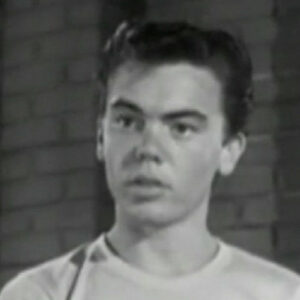
Robert Cletus “Bobby” Driscoll was an American child actor best known for his performances in several Walt Disney productions, including So Dear to My Heart, Treasure Island, and Song of the South. Born in Iowa, he later moved with his family to California. His acting career began at the age of five when he secured a small role following an audition. After appearing in several minor roles, he attracted the attention of Walt Disney Studios and signed a contract with the company. Driscoll went on to portray leading characters in several Disney films and received a special Juvenile Academy Award for Outstanding Juvenile Actor in 1949. Although Disney occasionally loaned him to other film studios, he remained closely associated with the company throughout much of his early career. He became particularly famous for voicing the title character in Disney’s animated film Peter Pan. He also served as a live-action reference model for the character, helping animators develop Peter Pan’s movements and expressions. However, his contract with Disney ended in 1953, three years before its original expiration date. Following his departure, he struggled to secure significant roles in other studios. He subsequently appeared mainly in television productions and radio programs. As his acting opportunities declined, Driscoll faced serious personal difficulties, including drug addiction. His substance abuse eventually led to his admission to a narcotics rehabilitation center. Despite these challenges, he later attempted to rebuild his artistic career by associating with Andy Warhol’s experimental art community, known as The Factory. However, his efforts to regain his former success were unsuccessful, and he eventually withdrew from public life while living in poverty. In 1968, his body was discovered in an abandoned building in New York City. He had died shortly after his 31st birthday, bringing a tragic end to the life of a former child star whose early performances had made him one of Disney’s recognizable young actors.
Childhood & Early Life
Robert Cletus “Bobby” Driscoll was born on March 3, 1937, in Cedar Rapids, Iowa. His mother, Isabelle (née Kratz), was a former schoolteacher, while his father, Cletus, worked as an insulation salesman. He was the only child of his parents and initially grew up in Des Moines. In 1943, the family relocated to Altadena, California, because his father’s work-related health problems prompted the move.
That same year, an acquaintance helped five-year-old Driscoll secure an audition at Metro-Goldwyn-Mayer (MGM) for a minor role in the film Lost Angel. Competing against approximately 40 other children, he successfully won the part, marking the beginning of his acting career.
Career of Bobby Driscoll
Following his screen debut, Driscoll appeared in the 20th Century Fox war film The Fighting Sullivans (1944), playing Al Sullivan, the youngest of five brothers. That year, he also appeared in Sunday Dinner for a Soldier, portraying a boy known for his unusual whistling trick, and The Big Bonanza, in which he played the younger brother of Richard Arlen’s character.
In 1946, Driscoll portrayed Percy Maxim in So Goes My Love. He also took on smaller roles in films such as Identify Unknown, From This Day Forward, O.S.S., and Miss Susie Slagle’s.
Driscoll became one of the earliest actors to sign a contract with Walt Disney Productions. His breakthrough came with Song of the South (1946), Disney’s blend of live-action and animation, in which he played the leading child character. His performance, alongside that of co-star Luana Patten, helped the pair gain considerable popularity. The media affectionately referred to them as “Walt Disney’s Sweetheart Team.”
Driscoll and Patten reunited for Disney’s So Dear to My Heart, another major live-action production. In 1948, he appeared as Eddie Cantor’s son in the RKO Studios musical comedy If You Knew Susie. He also appeared alongside Patten in the promotional segment for “Pecos Bill,” featured in Disney’s animated anthology Melody Time (1948).
In 1949, Driscoll was loaned to RKO Studios for the suspense film The Window. The production became a commercial success, and his performance received considerable praise. On March 23, 1950, he received a special Juvenile Academy Award recognizing him as the Outstanding Juvenile Actor of 1949 for his work in So Dear to My Heart and The Window.
Driscoll subsequently starred as Jim Hawkins in Disney’s live-action adaptation of Robert Louis Stevenson’s novel Treasure Island (1950). The film achieved international success, and Disney considered additional projects featuring him. However, several planned productions failed to materialize.
In 1951, Driscoll appeared in When I Grow Up, produced by Horizon Pictures, playing the dual roles of Danny and Josh Reed. He also made a brief appearance in Disney’s television special One Hour in Wonderland (1950). Additionally, he voiced Goofy Jr. in the animated shorts Fathers Are People (1951) and Father’s Lion (1952).
In the 1952 comedy The Happy Time, based on a Broadway play, Driscoll portrayed Robert “Bibi” Bonnard. One of the most significant roles of his career followed when he voiced the title character in Disney’s animated feature Peter Pan (1953). He also served as a reference model for the animators, particularly for close-up scenes. The film became a major success, further establishing his association with Disney.
At the height of his career, Driscoll’s weekly salary at Disney Studios reportedly increased to $1,750. However, his opportunities at the studio gradually declined after 1952. In March 1953, Disney terminated his contract three years before its scheduled expiration in 1956. His severe acne was reportedly cited as a factor, as concealing the condition required extensive makeup.
After leaving Disney, Driscoll struggled to find work because other studios continued to associate him with his former child-star image. From 1953 onward, he appeared primarily in television programs, including Front Row Center, Climax!, Navy Log, Fireside Theater, Ford Theatre, Dragnet, Studio One, Men of Annapolis, and Medic. He also participated in radio adaptations of Treasure Island (1951) and Peter Pan (1953). In recognition of his work in television and radio, he received a Milky Way Gold Star Award in 1954.
Following the termination of his Disney contract, Driscoll was transferred from Hollywood Professional School to University High School. He reportedly struggled to fit in with his new classmates, and his academic performance deteriorated. During this period, he began experimenting with drugs. He eventually returned to his former school and graduated in 1955.
By the age of 17, Driscoll had reportedly developed a regular drug habit. In 1956, he was arrested for marijuana possession, although the charges were subsequently dropped. Despite his personal difficulties, he continued pursuing acting opportunities and appeared in The Scarlet Coat (1955) and The Party Crashers (1958). His final television appearances came in 1960, with small roles in The Best of the Post and the crime series The Brothers Brannagan.
In 1960, Driscoll received a star on the Hollywood Walk of Fame at 1560 Vine Street. Despite this recognition, his personal struggles continued, and he was eventually sent to a narcotics rehabilitation center in Chino, California. After leaving the facility in 1962, he attempted unsuccessfully to rebuild his acting career.
In 1965, approximately a year after completing his parole, Driscoll moved to New York City in search of new opportunities. He hoped to find work on Broadway but was unable to establish himself there. He subsequently became associated with Andy Warhol’s experimental art collective, The Factory, where he explored his interest in visual art. Some of his artwork was later exhibited at the Santa Monica Museum of Art. His final film appearance was in Piero Heliczer’s experimental film Dirt (1965).
Between 1967 and early 1968, Driscoll reportedly left The Factory while experiencing severe financial and personal difficulties. On March 30, 1968, two boys discovered his body in an abandoned tenement building in New York City’s East Village. He had died from heart failure associated with advanced atherosclerosis, a condition involving the hardening of the arteries. His prolonged drug abuse was reported as a contributing factor.
Because he had no identification on him, his body initially remained unidentified and unclaimed. He was buried in an unmarked grave on Hart Island, New York City’s public burial ground.
In 1969, Driscoll’s mother began searching for him as his father’s health deteriorated. She contacted officials at Disney Studios for assistance. A fingerprint comparison eventually established his identity and led authorities to his grave on Hart Island.
When Song of the South was re-released in 1971 and 1972, members of the media attempted to locate the film’s principal cast members. During this process, they learned from Driscoll’s mother that the former child star had died several years earlier.
Family & Personal Life
In December 1956, Driscoll eloped with his girlfriend, Marilyn Jean Rush, and the couple married in Mexico. They held another wedding ceremony in Los Angeles in March 1957. Their marriage produced two daughters and one son. However, the relationship eventually ended in divorce in 1960.