

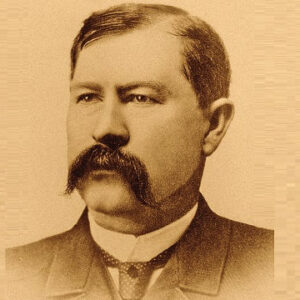
Virgil Walter Earp was an American Civil War veteran who served as a deputy U.S. marshal and city marshal. He is best remembered for leading his brothers, Morgan and Wyatt Earp, alongside Doc Holliday, during the infamous ‘Gunfight at the O.K. Corral.’ The brief, 30-second shootout involved a group of outlaws known as the ‘Cowboys’ and became one of the most celebrated gunfights in the history of the American Wild West. Virgil and his brothers had received repeated death threats and experienced numerous confrontations with members of the ‘Cowboys’ because they attempted to stop the group’s illegal activities. These tensions eventually culminated in the historic gunfight. During the confrontation, Virgil and Morgan were wounded, while Doc Holliday sustained a minor graze. On the opposing side, Tom and Frank McLaury and Billy Clanton were killed. Ike Clanton, who escaped the scene unharmed, subsequently accused the Earp brothers and Holliday of murder. However, all four men were acquitted after the court determined that they had acted in the line of duty. The conflict did not end with the gunfight. Members of the ‘Cowboys’ later attempted to assassinate Virgil, leaving him permanently disabled, and carried out another attack that resulted in Morgan’s death. The perpetrators were not indicted because of insufficient evidence. In response, Wyatt Earp, who had become a deputy U.S. marshal in Cochise County, set out to pursue and kill the men he believed were responsible. Following the attacks, Virgil moved to Colton, California, where he stayed at his parents’ home while recovering from his injuries. He eventually died at the age of 62 after developing pneumonia.
Early Life & American Civil War
Virgil Walter Earp was born on July 18, 1843, in Hartford, Kentucky, United States. He was the second son of Nicholas Porter Earp and his second wife, Virginia Ann Cooksey.
In February 1860, while living in Pella, Iowa, Virgil eloped with Magdalena C. “Ellen” Rysdam, a Dutch immigrant. The couple initially kept their marriage secret, but their families later disapproved of the union. Their daughter, Nellie Jane, was born in 1862.
Meanwhile, Virgil enlisted in the Union Army on July 26, 1861. On September 21, 1862, he was assigned to the Illinois Volunteer Infantry for a three-year term. On August 21, 1863, he was transferred to the 83rd Illinois Infantry. A minor offense resulted in a court-martial, after which he was penalized with a deduction of two weeks’ pay.
While Virgil was serving on active duty during the summer of 1863, Ellen’s father falsely informed her that Virgil had died in Tennessee. Believing the report, Ellen was subsequently married to a Dutch man named John Van Rossum, and the couple moved to the Oregon Territory. Virgil was discharged from the military on June 26, 1865. Afterward, he searched unsuccessfully for his wife and daughter. He eventually found work on a local farm before rejoining the Earp family in California.
In 1868, Virgil moved with his family to Lamar, Missouri. On August 28, 1870, he married Rosella Dragoo. Four years later, he met Alvira “Allie” Sullivan in Florence, Nebraska. Although the two never formally married, they remained partners for the rest of his life.
Throughout his career, Virgil held a variety of jobs, including mail carrier, sawmill worker, stagecoach driver, farmer, law enforcement officer, and prospector. According to Allie, he worked alongside his younger brother Wyatt as a deputy town marshal while staying with him in Dodge City, Kansas, in 1877. However, no surviving records have confirmed this claim.
In July 1877, Virgil and Allie moved to Prescott, Arizona, where he became the owner of a sawmill. He later accepted a position as a driver with a local freight company called Patterson, Caldwell & Levally. During his time in Arizona, he became acquainted with John J. Gosper, secretary of the Arizona Territory, and developed a friendship with Crawley Dake, the newly appointed U.S. marshal. In 1878, Virgil began working as Prescott’s night watchman and was appointed a constable in November of that year.
Deputy U.S. Marshal
On November 27, 1879, U.S. Marshal Crawley Dake appointed Virgil as deputy U.S. marshal for the Tombstone District of Pima County. His primary responsibility was to address ongoing disturbances involving a loosely organized group of outlaws known as the “Cowboys.”
On December 1, 1879, Virgil arrived in Tombstone with his brothers Wyatt and Jim, accompanied by their respective families.
On October 30, 1880, Virgil became Tombstone’s acting town marshal after the town marshal, Fred White, was accidentally killed by the outlaw “Curly Bill” Brocius. The following year, Tombstone’s mayor, John Clum, appointed Virgil to the permanent position of city marshal.
Gunfight at the O.K. Corral & Aftermath
In April 1881, the Tombstone City Council introduced an ordinance intended to reduce crime and maintain public order. Under the new regulation, carrying deadly weapons within the town was prohibited. Anyone entering Tombstone with a weapon was required to deposit it at a livery stable or saloon.
For months, members of the Cowboys repeatedly threatened the Earp brothers because of their efforts to interfere with the group’s unlawful activities. Virgil was eventually informed by local residents that several Cowboys had entered Tombstone while carrying firearms in direct violation of the ordinance.
On October 26, 1881, Virgil decided to enforce the law. Accompanied by deputy Morgan Earp and temporary deputies Wyatt Earp and Doc Holliday, he confronted Billy Claiborne, Billy and Ike Clanton, and Frank and Tom McLaury in an attempt to disarm them. The encounter escalated into a gunfight lasting approximately 30 seconds, beginning at around 3 p.m. About 30 shots were fired during the confrontation.
Although commonly called the “Gunfight at the O.K. Corral,” the famous shootout actually took place on Fremont Street, in a narrow lot beside the photographic studio of C. S. Fly, who witnessed the incident. The confrontation left Virgil and Doc Holliday injured and resulted in the deaths of Billy Clanton and the McLaury brothers. Ike Clanton, who maintained that he was unarmed, escaped with Wes Fuller and Billy Claiborne.
On October 30, 1881, Ike Clanton filed murder charges against the Earp brothers and Doc Holliday. During the following month, Justice of the Peace Wells Spicer heard testimony from several witnesses in an unusual preliminary hearing. He ultimately determined that there was insufficient justification for a trial and concluded that Virgil and the other lawmen had acted lawfully while performing their official duties. Consequently, the men were released from custody.
The gunfight gained widespread public attention through Stuart N. Lake’s bestselling 1931 biography, Wyatt Earp: Frontier Marshal. Although influential in shaping the popular image of Wyatt Earp as a fearless lawman of the American Old West, the book is now widely regarded as a highly imaginative and largely fictional account. It portrayed Wyatt as a heroic figure despite questions about the extent of his legal authority during the gunfight. The book later inspired films such as My Darling Clementine (1946) and Gunfight at the O.K. Corral (1957). The latter film became a box-office success, received two Academy Award nominations, and helped popularize the name by which the historic confrontation is widely known.
Despite the legal outcome, hostilities continued. On December 28, 1881, at approximately 11:30 p.m., Virgil was walking from the Oriental Saloon toward his room at the Cosmopolitan Hotel, where the Earp families had relocated following the gunfight. He was ambushed by gunmen firing from the second floor of a building now known as the Longhorn Restaurant. The attack severely damaged his left arm and left him permanently disabled.
While Virgil was recovering from his injuries, Morgan Earp was murdered by a Cowboy on March 18, 1882. However, alibis provided by other members of the group helped the suspects avoid conviction in both attacks.
On March 20, 1882, Virgil and Allie set out for Tucson, accompanied by Wyatt Earp, Warren Earp, “Turkey Creek” Jack Johnson, Doc Holliday, and Sherman McMaster. The group was heavily armed because they had learned that Ike Clanton and his associates were already in Tucson and intended to kill Virgil. With their assistance, Virgil and Allie boarded a train bound for California. As the train departed Tucson, gunfire could be heard. Virgil, Allie, and James eventually reached the Earp family home in Colton, California, bringing Morgan’s body with them.
Meanwhile, Wyatt, who had become a deputy U.S. marshal in Cochise County, concluded that the courts could not deliver the justice he sought. He organized a federal posse, including Warren Earp, to pursue the men he believed were responsible for Morgan’s murder and the attack on Virgil.
Wyatt and his posse embarked on what became known as the “Earp Vendetta Ride.” During the pursuit, they killed Frank Stilwell at the Tucson railway station, where he had reportedly been waiting to assassinate Virgil. The group also killed Florentino Cruz, “Curly Bill” Brocius, and Johnny Barnes. Subsequently, the Tucson Justice of the Peace issued arrest warrants for five members of the Earp party, including Wyatt, in connection with Stilwell’s death. On April 15, 1882, the group left the Arizona Territory permanently and headed toward the New Mexico Territory.
Later Life & Death
Virgil required approximately two years to recover from his injuries. Afterward, he was employed by the Southern Pacific Railroad to protect its tracks at Colton Crossing in Colton, California. The location had been the site of one of the most intense conflicts in railroad construction history, commonly described as a “frog war.” His work there eventually led to a personal confrontation with California Governor Robert Waterman.
In 1886, Virgil established a private detective agency. However, he abandoned the business after being appointed village constable in July of the same year.
On July 11, 1887, following Colton’s incorporation as a city, Virgil became its first city marshal. He was re-elected in 1888 but resigned later that year. He and Allie subsequently moved to San Bernardino before relocating to Vanderbilt, California, in 1893. While living there, Virgil operated a saloon and meeting place known as Earp’s Hall. In 1894, he ran for the position of town constable but was unsuccessful.
In 1898, Virgil received an unexpected letter from a woman identifying herself as “Mrs. Levi Law.” He later discovered that she was Nellie, his only daughter from his first marriage to Ellen. He traveled to Portland, Oregon, where he reunited with Ellen and Nellie. The reunion brought him great happiness, particularly when he learned that he had three grandchildren.
In 1904, Virgil and Allie moved to Goldfield, Nevada, where they joined Wyatt. Virgil subsequently served as a deputy sheriff in Esmeralda County, Nevada. After suffering from pneumonia for approximately six months, he died on October 19, 1905, at the age of 62.
At his daughter’s request, Allie arranged for Virgil’s remains to be transported to Portland, Oregon. He was laid to rest at River View Cemetery.