

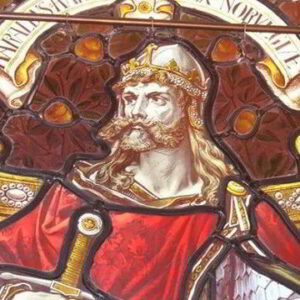
Harald Hardrada was a Norwegian king widely known as the “Hard Ruler.” Regarded as the last great Viking ruler, he was notorious for his harsh and authoritarian leadership. The name “Hardrada,” given to him in the sagas, reflected his strict governing methods. Highly ambitious, he constantly sought opportunities to expand his kingdom and made unsuccessful attempts to claim the Danish and English thrones. Born into the family of a wealthy chieftain, Hardrada displayed a rebellious nature from an early age. He fought alongside his half-brother, Olaf Haraldsson, at the Battle of Stiklestad. After their defeat, Hardrada escaped to Kievan Rus, where he joined the army of Yaroslav the Wise. He later traveled to Constantinople and rose to become a commander in the Byzantine army. After spending several years in the East and accumulating substantial wealth, Hardrada returned to Norway to claim the throne. Magnus, who was ruling Norway at the time, was reluctant to engage in battle with Hardrada, his uncle, and agreed to share the kingdom with him. Following Magnus’s death, Hardrada became Norway’s sole ruler. His desire to conquer Denmark resulted in several unsuccessful military campaigns. He also set his sights on the English throne. Although his initial efforts met with some success, he was eventually defeated and killed by the forces of Harold Godwinson at the Battle of Stamford Bridge. Hardrada’s death is widely regarded as a defining event in the end of the Viking Age.
Childhood & Early Life
Harald Hardrada was born in Ringerike, Norway, to Sigurd Syr and Asta Gudbrandsdatter. His birth is generally dated to 1015 or 1016, although the exact date remains uncertain. According to certain legends, Sigurd Syr was a great-grandson of King Harald Fairhair. A prosperous chieftain, Sigurd preferred agricultural pursuits over political leadership.
Olaf Haraldsson, later revered as Saint Olaf, was Harald Hardrada’s half-brother. From an early age, Hardrada exhibited a rebellious temperament and greatly admired Olaf’s leadership qualities. Unlike his father and elder brothers, who showed little interest in warfare, Hardrada was drawn to military affairs and adventure.
Career of Harald Hardrada
In 1030, Olaf Haraldsson returned to Norway after spending two years in exile, hoping to reclaim the throne seized by the Danish king, Cnut the Great. Harald Hardrada joined his half-brother’s forces in the campaign against the Danes. However, their efforts ended in defeat at the Battle of Stiklestad, where Olaf was killed. Hardrada was forced to escape to save his life.
Following the defeat, Hardrada sought refuge in Kievan Rus, where he received a welcome from Grand Prince Yaroslav the Wise. He was appointed captain of Yaroslav’s army and participated in the prince’s campaign against Poland in 1031. He subsequently fought in several other military campaigns on behalf of the Kievan ruler.
After spending several years in Kievan Rus, Hardrada traveled to Constantinople, the capital of the Byzantine Empire. There, he joined the Varangian Guard, an elite military unit responsible for protecting the Byzantine emperor. He initially concealed his royal background but eventually earned widespread recognition for his exceptional fighting skills and military accomplishments.
In 1035, Hardrada took part in Byzantine military campaigns against Arab forces in Asia Minor. He led his troops as far as the Tigris River and contributed significantly to the capture of several Arab strongholds. He later participated in military operations in Jerusalem and Sicily. During Emperor Michael IV’s reign, Hardrada remained a loyal and active member of the Byzantine army, fighting in several engagements, including the battles of Olivento and Ostrovo.
Following Michael IV’s death, a power struggle developed between the new emperor, Michael V, and Empress Zoe. Because of his allegiance to the previous emperor, Hardrada was imprisoned. He later helped lead a rebellion by the Varangian Guard against Michael V. The revolt resulted in the emperor’s removal and exile, while Empress Zoe regained her position. Hardrada played an important role in these political developments.
After accumulating considerable wealth in Constantinople, Hardrada returned to Kievan Rus. Although Empress Zoe opposed his departure, he managed to escape with several loyal followers. During his stay, he married Elisabeth, the daughter of Yaroslav the Wise.
In 1045, Hardrada began his campaign to secure the Norwegian throne. At that time, Norway was ruled by Magnus the Good. Hardrada initially allied himself with Sweyn II, a claimant to the Danish throne, in an effort to challenge Magnus. However, Magnus was unwilling to fight his own uncle and eventually agreed to share the Norwegian kingdom with Hardrada. In exchange, Hardrada contributed part of his accumulated wealth. When Magnus died the following year without an heir, Hardrada became the sole ruler of Norway.
Hardrada possessed considerable ambition and sought to extend his kingdom’s influence as far as possible. Between 1048 and 1064, he launched numerous military campaigns against Denmark. Although he achieved victories in some engagements, he ultimately failed to seize the Danish throne. In 1065, he reached a peace agreement with Sweyn, the Danish king. Under the terms of the treaty, both rulers agreed to retain their existing territories.
In 1066, having settled his conflict with Denmark, Hardrada turned his attention to England. The English throne was then held by Harold Godwinson. Hardrada formed an alliance with Tostig Godwinson, the king’s brother, who had become hostile toward Harold. Accompanied by his forces, Hardrada left Norway to pursue his claim to the English throne.
Initially, Hardrada and Tostig achieved some military success. However, their campaign ended disastrously at the Battle of Stamford Bridge, where King Harold’s army defeated the invading Norse forces. Hardrada, who was reportedly fighting without his armor, was struck by an arrow and killed in the battle.
Hardrada was remembered for his severe approach to governance and his willingness to settle disputes through force. His reputation for strictness earned him descriptions such as the “Hard Ruler” and “Savage in Counsel.” Despite his harsh methods, he was also associated with economic development. He strengthened Norway’s monetary system and is traditionally credited with founding the city of Oslo.
Family, Personal Life & Legacy
According to historical sagas, Harald Hardrada married twice. During his time in Kievan Rus, he married Elisabeth, the daughter of Yaroslav the Wise. However, reliable information about the number of children they had is limited.
Hardrada also married Tora Torbergsdatter, a member of a powerful Norwegian family. Some historians have questioned the details of this marriage, and accounts of his family life are not entirely consistent.
Contemporary descriptions portray Hardrada as a physically strong and imposing man whose appearance could intimidate his enemies. Following his death at the Battle of Stamford Bridge, his body was transported to Norway and buried at the Mary Church in Nidaros. Nearly a century later, his remains were reportedly transferred to Helgester Priory.
Harald Hardrada remains a significant figure in Norwegian history, remembered for his military campaigns, his ambitious attempts to expand his kingdom, and his role in the events traditionally associated with the end of the Viking Age. Several monuments in Oslo commemorate his life and legacy.