

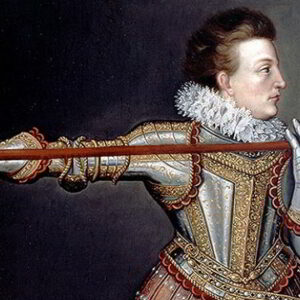
Henry Frederick was the eldest son of King James VI of Scotland and I of England and Queen Anne of Denmark. He served as Prince of Wales from 1610 until his death in 1612. Born in Scotland during the closing years of the sixteenth century, Henry was the heir apparent to the English and Scottish thrones. Only a few days after his birth, he was separated from his mother and placed under the care of carefully chosen governors and tutors, who were entrusted with raising and educating him as a model Protestant prince. When his father inherited the English throne in 1603, Henry moved to England along with the royal family. Although he was only nine years old, he quickly impressed the English court with his intelligence, confidence, and maturity, leading to the establishment of his own royal household. Known for his love of learning, literature, and collecting art and books, Henry gained widespread admiration from both courtiers and the public. As he grew older, he gradually assumed greater responsibilities in matters of state. His abilities and leadership qualities made him one of the most promising royal heirs of his generation. In 1610, at the age of sixteen, he was formally invested as Prince of Wales, after which he became increasingly involved in royal affairs. However, his promising future was cut short when he died in 1612, at just 18 years of age, most likely from typhoid fever. His untimely death was deeply mourned by his family, the royal court, and people across England and Scotland, who had viewed him as a hopeful future monarch.
Childhood & Early Years
Henry Frederick was born on 19 February 1594 at Stirling Castle, Scotland. At the time of his birth, his father, James VI of Scotland, ruled as King of Scotland. In 1603, after inheriting the English throne following the death of Queen Elizabeth I, James also became James I of England and Ireland, uniting the crowns of Scotland and England under one monarch.
His mother, Anne of Denmark, was the daughter of King Frederick II of Denmark. Although King James was a committed Protestant, Anne was believed to have strong Roman Catholic sympathies, leading to disagreements between the royal couple.
Henry was named in honor of his grandfathers, Henry Stuart, Lord Darnley, and King Frederick II of Denmark. As the eldest son of the king, he automatically inherited several Scottish titles at birth, including Duke of Rothesay, Earl of Carrick, Baron of Renfrew, Lord of the Isles, and Prince and Great Steward of Scotland.
Of the seven children born to James and Anne, only Henry and two younger siblings survived into adulthood: Elizabeth, later Queen of Bohemia, and Charles, who eventually became King Charles I of England. Their other children—Margaret, Robert, Mary, and Sophia—died in infancy.
Soon after Henry’s birth, King James removed him from his mother’s care to ensure he would be raised in a firmly Protestant environment. His former nurse, Helen Little, was appointed head of the royal nursery, while John Erskine, Earl of Mar, became his guardian. Queen Anne was excluded from decisions regarding her son’s upbringing, a situation that caused her considerable distress.
Henry was baptized with great ceremony on 30 August 1594 in the newly built Chapel Royal at Stirling Castle. Later that year, Queen Anne unsuccessfully attempted to regain custody of her son with the support of several influential nobles. King James firmly instructed that Henry should remain under the Earl of Mar’s care under all circumstances.
From an early age, Henry was educated to become an ideal Renaissance Protestant ruler and a future defender of the Protestant faith. King James took an active role in directing his education, selecting tutors and personally preparing lessons. Rather than functioning as a traditional royal court, Henry’s household was organized more like an academic institution.
Among his early tutors were Sir George Lauder of the Bass, Sir David Murray of Gorthy, and later Sir Adam Newton, who supervised much of his education between 1600 and 1610.
Queen Regains Custody
Following the death of Queen Elizabeth I on 24 March 1603, James VI inherited the English throne as James I, becoming ruler of both Scotland and England.
On 5 April 1603, James departed for London to prepare for his English coronation, accompanied by the Earl of Mar. With his father’s accession, Henry automatically became Duke of Cornwall, the traditional title granted to the eldest son of the English monarch.
While the king was away, Queen Anne traveled to Stirling Castle in an attempt to reclaim her nine-year-old son, whom she had not seen for several years. Lady Mar refused her request, citing the king’s explicit written orders. When the Earl of Mar later returned with instructions for the queen to join the king in England, Anne refused unless Henry was placed in her care. Faced with her determination, King James eventually relented and restored custody of their son to her.
In London
On 1 June 1603, Henry left Scotland with his mother and arrived at Windsor on 30 June. Just two days later, he was invested as a Knight of the Order of the Garter, where his intelligence, confidence, and respectful conduct made a strong impression on the English court.
To protect him from a plague outbreak, Henry was soon moved to Oatlands Palace in Surrey before later establishing his own household at Nonsuch Palace, supported by an annual allowance of 1,000 marks. He also spent time at Hampton Court Palace.
His education continued under Sir Adam Newton and Sir David Murray, the latter serving in several senior positions within the prince’s household. Alongside academic studies, Henry trained in activities expected of a future monarch, including hawking, hunting, jousting, fencing, and music, studying under composer Alfonso Ferrabosco the Younger.
Influenced by his mother’s appreciation for the arts, Henry developed a lifelong passion for collecting paintings, sculptures, medals, and other works from classical antiquity and the Renaissance. He particularly admired religious and mythological artworks from the Netherlands and Venice.
In 1605, he was associated with Magdalen College, Oxford, where he earned admiration for his debating skills. Following the discovery of the Gunpowder Plot later that year, he developed a keen interest in military and naval affairs.
Henry joined the Merchant Taylors’ Company in London in 1607. By this stage, his maturity had become widely recognized. In 1608, he publicly defended his servant and friend Phineas Pett, who had been wrongly accused of misconduct and was later cleared of all charges.
As a scholar, Henry gained an excellent reputation. After Lord Lumley’s death in 1609, his extensive library was transferred to Henry, further enriching his collection of books.
During his teenage years, Henry increasingly demonstrated leadership qualities and assumed various official responsibilities. A devout Protestant, he regularly attended sermons and insisted on respectful conduct within his household. His growing popularity among the public led to rumors of rivalry with his father, although historians have found little evidence to support such claims. In reality, King James was deeply devastated by his son’s untimely death.
Prince of Wales
In 1610, Parliament approved Henry’s formal investiture as Prince of Wales. During a magnificent ceremony held that June, he officially received the title, along with the title of Earl of Chester.
Following the ceremony, Henry established his household at St. James’s Palace, where he continued expanding his impressive art collection with guidance from Thomas Howard, Earl of Arundel. He also appointed Abraham van der Doort to catalogue his growing collection.
As Prince of Wales, Henry became increasingly involved in government affairs. He supported the Virginia Company by assigning Sir Thomas Dale to its North American colony and expressed interest in achieving peace with Irish rebels. His former tutor, Sir David Murray, now served as his secretary.
Despite his growing political responsibilities, Henry maintained his enthusiasm for art and architecture. In 1612, he commissioned decorative waterworks for the gardens at Richmond Palace, one of his final artistic projects.
Marriage Proposals
Several diplomatic marriage proposals were arranged for Prince Henry during his lifetime. In 1604, discussions began regarding a marriage with Infanta Anne of Spain, but the proposal failed after Spain insisted that Henry be raised as a Catholic. Similar negotiations in 1605 and 1607 were also unsuccessful.
Another proposal emerged in 1611, suggesting a marriage to the eldest daughter of the Duke of Savoy. However, the plan received little support in England, and Henry himself showed no enthusiasm for the match, causing the negotiations to end.
Death & Legacy
In 1612, preparations began for the marriage of Henry’s sister Princess Elizabeth to Frederick V, Count Palatine of the Rhine. Henry played an active role in organizing the celebrations, including arranging the royal fleet that would accompany his sister across the sea.
During these preparations, he is believed to have contracted typhoid fever. Around 12 October 1612, he developed a fever that gradually worsened over the following weeks, accompanied by severe gastrointestinal symptoms, insomnia, and increasing weakness.
After playing tennis on 25 October, his condition deteriorated significantly. Although he dined with his father that evening, observers noticed his rapid pulse and flushed appearance. High fever, abdominal swelling, and intense thirst soon followed.
Henry Frederick died on 6 November 1612 at just 18 years of age. Although rumors initially suggested he had been poisoned, later medical assessments concluded that he most likely died from typhoid fever.
His body remained at St. James’s Palace until his funeral on 7 December 1612. Approximately 2,000 mourners accompanied the funeral procession to Westminster Abbey, where George Abbot, Archbishop of Canterbury, delivered the funeral sermon. Memorial services were also held in Oxford, Cambridge, and Bristol.
Henry was buried in the vault of his grandmother, Mary, Queen of Scots, in the Henry VII Chapel at Westminster Abbey. Despite his status and popularity, no monument was erected in his memory.
Neither of his parents attended the funeral. King James was overwhelmed with grief, while Queen Anne was so devastated that she could scarcely bear to hear her son’s name mentioned. Henry’s younger brother, Charles, then only ten years old, served as the chief mourner.
Henry’s death prompted an extraordinary outpouring of public sorrow. Within a month, more than thirty poets, including Thomas Campion, George Chapman, George Wither, John Davies, and Sir William Alexander, had composed elegies honoring the young prince.
Trivia
Following Henry Frederick’s death, his younger brother Charles became heir to the throne and later ruled as King Charles I. Unlike Henry, Charles had not been prepared from childhood to become king. His reign eventually contributed to the outbreak of the English Civil War, leading many historians to speculate that British history might have taken a very different course had Henry lived to inherit the crown.