

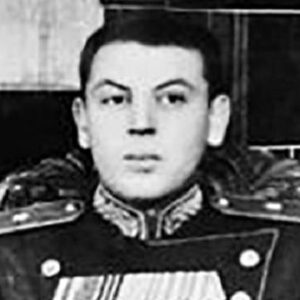
Vasily Iosifovich Stalin was a Soviet military officer and aviator best known as the son of Soviet leader Joseph Stalin, who governed the Soviet Union for more than three decades. He was born to Joseph Stalin and his second wife, Nadezhda Alliluyeva. Vasily’s childhood changed dramatically after his mother died by suicide, leaving him and his sister, Svetlana, to be raised largely under the supervision of their father’s staff. Vasily joined the Red Air Force and trained as a fighter pilot, advancing rapidly through the military ranks. Owing to his swift promotions, he attained the rank of Lieutenant-General in 1947. The following year, he was appointed Commander of the Air Forces of the Moscow Military District, one of the Soviet Union’s most important military positions. His fortunes changed significantly after Joseph Stalin’s death in 1953. Within two months of his father’s passing, Vasily was arrested on charges of disclosing classified state information. He was sentenced to eight years of imprisonment and corrective labor. After completing his sentence, Soviet authorities granted him a monthly pension of 300 rubles, a three-month stay in Kislovodsk, and an apartment in Moscow. He was also permitted to wear his general’s uniform and military decorations. Vasily Stalin died on March 19, 1962.
Childhood & Early Life
Vasily Iosifovich Stalin was born on March 21, 1921, in Moscow, Russian SFSR, Soviet Union, to Joseph Stalin and his second wife, Nadezhda Alliluyeva. He had one younger sister, Svetlana, and two half-brothers, Yakov Dzhugashvili and Konstantin Kuzakov.
Beginning in 1922, Joseph Stalin emerged as the leader of the Soviet Union, serving as the General Secretary of the Communist Party of the Soviet Union for more than three decades. From 1941 until his death in 1953, he also held the office of Premier of the Soviet Union.
Vasily spent his early years in the Kremlin, surrounded by luxury, private tutors, servants, and expensive toys. His life changed dramatically after his mother died from a self-inflicted gunshot wound on November 9, 1932, although Soviet authorities officially announced that she had died of appendicitis. Following her death, Stalin became emotionally distant from Vasily and Svetlana. The siblings were primarily raised by their nursemaid and members of Stalin’s security staff, while an officer named Sergei Efimov was assigned to supervise their upbringing.
Academically, Vasily was an average student and completed school with unimpressive grades. Despite this, he aspired to attend the prestigious aviation academy at Kacinsk. Thanks to the intervention of influential Soviet politician Lavrentiy Beria, he secured admission despite his poor academic record. During his early days at the academy, he enjoyed privileges such as a private room and special meals, but these benefits were later withdrawn on Joseph Stalin’s direct orders.
Like his father, Vasily developed a forceful and manipulative personality. Over time, he earned a reputation as a heavy drinker and womanizer. Although his excessive alcohol consumption often affected his behavior, he successfully qualified as a military pilot. Throughout his career, he frequently relied on his family name and political influence to obtain promotions, something his father strongly disapproved of, believing that Vasily had become spoiled.
Career of Vasily Stalin
Vasily launched his military career with the 16th Fighter Aviation Regiment in Moscow. During the opening phase of the Second World War, he served as an Inspector of Air Forces within the Soviet General Staff. His advancement through the Red Air Force was exceptionally rapid, allowing him to enjoy a privileged and luxurious lifestyle.
He was promoted to the rank of major in December 1941 and became a colonel only a few months later. In January 1943, he assumed command of the 32nd Guards Fighter Aviation Regiment. Despite his impressive military appointments, he gained a poor reputation due to his irresponsible conduct, excessive drinking, short temper, and rude behavior. At one point, Joseph Stalin dismissed him for “hard drinking, debauchery, and corrupting the regiment,” though he was reinstated approximately seven months later.
Between February and March 1943, Vasily flew 26 combat sorties. On March 5, 1943, he shot down a German Focke-Wulf Fw 190 Würger fighter aircraft and claimed another German aircraft within the following days.
His military career continued to progress after the war. In 1946, he was promoted to Major-General, followed by his promotion to Lieutenant-General in 1947. The following year, he became Commander of the Air Forces of the Moscow Military District.
Apart from his military responsibilities, Vasily actively supported the Soviet Air Force sports club, VVS Moscow, eventually serving as its president. Tragedy struck on January 5, 1950, when a Lisunov Li-2 transport aircraft carrying most members of the VVS Moscow ice hockey team crashed near Koltsovo Airport during severe weather, killing all 19 people aboard. Fearing his father’s reaction, Vasily assembled an entirely new hockey team within just 24 hours, retaining only the three players who had not boarded the doomed flight.
On July 27, 1952, he insisted that military aircraft participate in a parade despite dangerous weather conditions. During the event, a Tupolev Tu-4 strategic bomber crashed, and the incident resulted in his dismissal from military service.
Life After Stalin’s Death
Following Joseph Stalin’s death on March 5, 1953, Vasily’s fortunes declined rapidly. On April 28, 1953, he was arrested after allegedly revealing classified state secrets to foreign diplomats during a dinner gathering. Authorities also charged him with criminal negligence, anti-Soviet propaganda, and defaming Soviet leaders.
During the investigation, led by prosecutor Lev Yemelianovich Vlodzimirsky, Vasily admitted guilt to all charges. He requested clemency, but the appeal was rejected by the new Soviet leadership under Nikita Khrushchev and Georgy Malenkov. He was denied legal representation and tried behind closed doors before receiving a sentence of eight years of imprisonment combined with disciplinary labor. He served his sentence in Vladimir Prison under the assumed name “Vasily Pavlovich Vasilyev.”
On January 11, 1960, Vasily was released from prison. The Central Committee of the Communist Party of the Soviet Union approved a monthly pension of 300 rubles for him, provided him with an apartment in Moscow, and granted him a three-month treatment stay in the spa resort of Kislovodsk in Stavropol Krai. He was also permitted to wear his military uniform and display the medals he had earned during his service.
Despite these concessions, Vasily failed to reform his lifestyle. He resumed excessive drinking and frequently became involved in disturbances. Within a year of his release, he was imprisoned again following a traffic-related incident. Owing to declining health, he was released before completing his sentence and was subsequently exiled to Kazan, where he spent the remainder of his life.
Family & Personal Life
At the age of 19, Vasily married Galina Burdonskaia. Over the years, he entered into several more marriages, including with Kapitolina Georgievna Vasil’yeva, Yekaterina Semyonovna Timoshenko, and Maria Ignat’yeva Nusberg.
On March 19, 1962, Vasily Stalin died in Kazan due to complications arising from chronic alcoholism. Decades later, in 1999, part of his reputation was officially rehabilitated when the Soviet-era accusations of anti-Soviet propaganda made against him in 1953 were overturned. In 2002, his remains were reburied in a Moscow cemetery beside the grave of his fourth wife.
Vasily Stalin has also been portrayed in popular culture. He appeared as a character in the 1991 film My Best Friend, General Vasili, Son of Joseph Stalin, played by Vladimir Steklov, and in the 2017 political satire The Death of Stalin, where he was portrayed by Rupert Friend.