

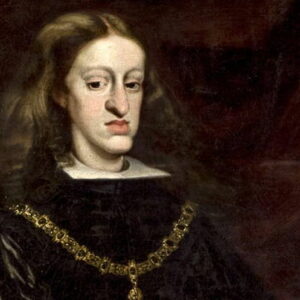
As the final monarch of the Spanish Habsburgs, Charles II represented the tragic culmination of a dominant lineage that collapsed due to inbreeding. Historically referred to as “El Hechizado” or “The Bewitched,” he is primarily recognized for the severe medical complications that caused his passing at 38 without leaving a successor. These physical impairments were widely attributed to the family’s habit of marrying close kin, such as cousins and nieces; notably, Charles was born to a father who was also his mother’s uncle. Profound disabilities plagued his daily existence: an abnormally large tongue made clear speech impossible, and his frail legs were unable to sustain his weight for walking. Alongside a misshapen facial structure, he endured chronic intestinal distress, and reports from his spouse suggested he was unable to father children. Following his inevitable decline and death, his testament designated Philip of Anjou – the grandson of the French King Louis XIV – as the next king. This appointment sparked intense international conflict, culminating in the 1701 War of the Spanish Succession. This struggle eventually led to the Treaty of Utrecht, a settlement that allowed Austria to emerge with significant territorial gains across Europe.
Childhood and Early Life
Charles II was born in Madrid on November 6, 1661, to Philip IV and Mariana of Austria. Because his parents were uncle and niece, his lineage was an extreme example of inbreeding; all eight of his great-grandparents were descendants of the same two ancestors, Joanna and Philip I of Castile. This genetic history took a severe toll on Charles, though his half-sister, Margaret, appeared unaffected by similar conditions.
Charles was born with an elongated head and the prominent “Habsburg jaw.” His upper and lower teeth did not meet, which made eating and speaking exceptionally difficult. His development was significantly delayed: he was breastfed until age five or six, did not speak until age four, and could not walk until he was eight. Throughout his youth, he suffered from a constant barrage of illnesses, including measles, smallpox, epileptic seizures, and chronic intestinal issues.
Career and Reign
When his father died in 1665, three-year-old Charles became king. Although he was meant to take full power at age 14, his mother, Queen Regent Mariana, maintained control by arguing that he was mentally and physically unfit to rule. In 1675, Charles briefly asserted his authority with the help of his half-brother, Juan José, but after Juan died in 1679, Charles returned to his mother’s influence. Ultimately, historians note that Charles “only reigned but never ruled,” as his power was always exercised by others.
His reign was marked by the steady decline of the Spanish Empire. Bankrupt and with a weakened military, Spain was forced into several treaties to end conflicts, including the Treaty of Aix-la-Chapelle and the Treaty of Lisbon. However, repeated wars with France—such as the Franco-Dutch War and the Nine Years’ War—exhausted the nation’s remaining wealth. By the time Charles reached his thirties, he was a weak leader presiding over a crumbling state while foreign powers waited to claim his territories.
Personal Life and Death
Charles married twice in hopes of producing an heir. His first marriage to Marie Louise of Orléans in 1679 was unhappy, as she struggled with his physical limitations and the pressure to conceive. After she died in 1689, he married Maria Anna of Neuburg, but this union also remained childless. By age 35, Charles had gone bald, his eyesight was failing, and he could barely speak. Desperate for a cure, his court turned to exorcisms, believing the king was “bewitched” rather than suffering from genetic decay.
Charles II passed away on November 1, 1700, just before his 39th birthday. An autopsy revealed severe internal abnormalities, including a withered heart and fluid in his brain. According to his will, he named Philip of Anjou, the grandson of Louis XIV, as his successor. This decision triggered the War of the Spanish Succession in 1701, which eventually ended the Habsburg dynasty’s rule in Spain and led to the rise of Austrian influence through the Treaty of Utrecht.
Net worth of Charles II of Spain
The estimated net worth of Charles II of Spain is about $200 million.