

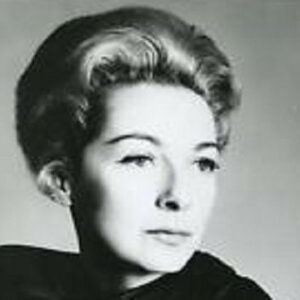
Felicia Cohn Montealegre was a Chilean stage and television actress, primarily known as the wife of the legendary American composer and conductor Leonard Bernstein. An accomplished pianist, she honed her musical talents under the tutelage of the renowned Claudio Arrau and later collaborated with her husband by providing narration for several of his works, including his ‘Kaddish’ symphony. Her acting career included roles in prominent TV anthology series like ‘Studio One’ and ‘Kraft Television Theatre,’ as well as Broadway productions such as ‘The Merchant of Venice,’ though she never made the transition to film. Beyond her artistic pursuits, she was a dedicated activist who helped found the anti-war group ‘Another Mother for Peace.’ Despite a deep mutual affection, her marriage was complicated by Bernstein’s homosexuality—a fact she famously addressed in a letter expressing her acceptance of his true self. A mother of three, Felicia died of lung cancer at the age of 56. Her life and social influence were notably immortalized in Tom Wolfe’s famous essay, ‘Radical Chic: That Party at Lenny’s.’
Childhood & Early Life
Felicia Cohn Montealegre was born on March 3, 1922, in San José, Costa Rica, to parents Roy Elwood Cohn and Clemencia Montealegre Carazo. Raised in the Catholic faith, she completed her schooling in Chile before relocating to New York. In the city, she studied piano under the legendary Claudio Arrau, who is widely considered one of the 20th century’s most accomplished pianists.
Career of Felicia Montealegre
Felicia established a prolific career in television during the late 1940s and 1950s. She was a frequent star in the “Golden Age” of live TV, appearing in 11 episodes of Kraft Television Theatre, where she played iconic characters such as Nora in Ibsen’s A Doll’s House and Emma Woodhouse in Emma. Simultaneously, she became a staple of the Studio One anthology series, portraying roles in teleplays like Of Human Bondage and The Wings of the Dove.
Her artistic range extended to the stage and classical music. She appeared in Broadway productions including The Merchant of Venice (1953), The Little Foxes (1967), and Poor Murderer (1976). While she never appeared in feature films, she collaborated musically with her husband, Leonard Bernstein, providing narration for his Kaddish symphony and Debussy’s Le martyre de Saint Sébastien.
Beyond the arts, Felicia was a staunch activist. In 1967, she co-founded the anti-war group “Another Mother for Peace” to protest the Vietnam War. In 1970, she and Bernstein drew national attention—and a degree of controversy—for hosting a fundraiser for the Black Panther Party, an event famously chronicled by Tom Wolfe in his essay Radical Chic: That Party at Lenny’s.
Family & Personal Life
Felicia met Leonard Bernstein at a party in 1946. Though they were briefly engaged, they separated for several years, during which Felicia was in a relationship with actor Richard Hart. Following Hart’s death, she married Bernstein on September 10, 1951, and subsequently converted to Judaism. The couple had three children: Jamie, Alexander, and Nina.
Their marriage was famously complex due to Bernstein’s homosexuality. While the union was characterized by deep emotional affection and mutual respect, Felicia was aware of his private struggles and extramarital affairs. In a poignant letter published decades later, she expressed her acceptance of his true nature, noting that she was “willing to accept you as you are.”
In 1976, Bernstein briefly left Felicia to live openly with Tom Cothran; however, he returned to her side upon her lung cancer diagnosis in 1977. He remained her primary caregiver until her passing on June 16, 1978, in East Hampton, New York.
Net worth of Felicia Montealegre
The estimated net worth of Felicia Montealegre is about $10 million.