

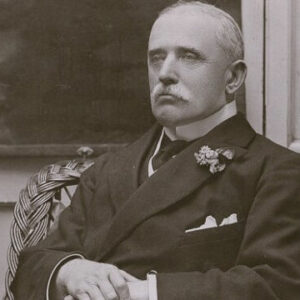
John French, 1st Earl of Ypres, was a distinguished British Army officer who played a prominent role in Britain’s military history. Over the course of his career, he held several prestigious ranks and titles, including Field Marshal, Viscount, and later Earl of Ypres. He began his military service as a midshipman in the Royal Navy before transferring to the British Army, where he earned recognition for his contributions during the Gordon Relief Expedition in Sudan. French rose to national prominence following the Second Boer War, during which he commanded the Cavalry Division at the Battle of Klip Drift. His military successes earned him widespread public admiration and established him as one of Britain’s leading soldiers. He was later appointed Chief of the Imperial General Staff, but resigned after becoming involved in a dispute over the implementation of the Home Rule for Ireland policy. During the First World War, French served as the commander-in-chief of the British Expeditionary Force. However, his leadership came under increasing criticism, with many questioning his temperament and strategic judgment. Under his command, British forces suffered significant losses in battles such as Mons and Le Cateau, eventually leading to his removal from the post. Following his departure from frontline command, French became commander-in-chief of the Home Forces and was later appointed Lord Lieutenant of Ireland. After retiring from active military service, he was honored with the title Earl of Ypres in recognition of his long career. Despite his achievements, French remained a controversial figure. He faced criticism for his personal relationships and for what many viewed as ineffective military leadership. His memoirs also attracted considerable debate, with historians accusing him of presenting an inaccurate account of several important events.
Childhood & Early Life
John French was born on September 28, 1852, in Kent, England, into an Anglo-Irish family. His father, Commander John Tracey William French, had served in military operations during the Portuguese Civil War, while his mother, Margaret Eccles, later suffered a mental breakdown after the death of her husband and was declared mentally unwell.
French grew up in a family with six sisters and was primarily raised by them after his parents’ death. He received his early education at a preparatory school in Harrow and later enrolled at Eastman’s Royal Naval Academy in Portsmouth. Although his family had lived in England for generations, French strongly identified himself as Irish.
Career of John French, 1st Earl of Ypres
French began his military journey in 1866 by joining the Royal Navy. In 1869, he served as a midshipman aboard HMS Warrior, but later left naval service due to seasickness and acrophobia.
In 1870, he entered the Suffolk Artillery Militia and, four years later, was commissioned as a lieutenant in the 8th King’s Royal Irish Hussars. He was later transferred to the 19th Hussars, where he developed strong equestrian and hunting skills. By 1880, he had risen to the rank of captain.
In 1884, French participated in the Sudan (Nile) Expedition aimed at relieving Major General Charles Gordon. His performance during the campaign earned him recognition and promotion to lieutenant colonel.
In 1891, while stationed in India with the 19th Hussars, French became involved in an extramarital affair with the wife of a fellow officer. The scandal became public and temporarily damaged his career, resulting in a period on half-pay.
After this setback, he was appointed assistant adjutant-general at Army Headquarters. With support from influential figures such as Douglas Haig, French returned to active service and was promoted to major-general.
French played a significant role in the Second Boer War, serving under Field Marshal Frederick Roberts. He commanded cavalry operations in regions such as Colesberg, where he helped block Boer advances. During the Klip Drift operations, he gained praise for his tactical leadership and confidence in the field.
In 1901, he was appointed Knight Commander of the Order of the Bath in recognition of his Boer War service. In the later stages of the war, he served under Field Marshal Herbert Kitchener, who, despite personality differences, acknowledged French’s dedication and reliability.
By 1902, French had become commander-in-chief of the 1st Army Corps. His career continued to advance, and in 1907 he was appointed Inspector General of the Army. In 1911, he became an aide-de-camp general to King George V. He was also involved in the “cavalry controversy,” advocating that cavalry units should retain traditional weapons like the sword and lance while also receiving firearms training.
In 1912, French was appointed Chief of the Imperial General Staff, but political tensions surrounding the Home Rule crisis in Ireland led to his resignation. In 1914, he was appointed commander of the British Expeditionary Force (BEF) at the outbreak of the First World War.
During World War I, French’s leadership proved controversial. He clashed with French commander Charles Lanrezac and faced heavy losses at the battles of Mons and Le Cateau. His desire to withdraw the BEF created tensions with Allied leadership. He also had disagreements with Lord Kitchener and was criticized for slow coordination, particularly after the Battle of Loos. By 1915, public and political pressure led to his resignation, and he was replaced by Douglas Haig.
In 1916, he became commander-in-chief of the British Home Forces, where he played a role in suppressing the Easter Rising. He later served as Lord Lieutenant of Ireland during a turbulent political period and resigned in 1921. After retiring, he was elevated to the title of Earl of Ypres.
Family & Personal Life
In 1875, John French secretly married Isabella Soundy, as marriage was initially restricted for officers of his rank. The marriage ended in separation in 1878. In 1880, he married Eleanora Selby-Lowndes, with whom he had two sons, John and Gerald—and a daughter named Essex. Another daughter tragically died in infancy due to accidental suffocation by a nurse.
John French died on May 22, 1925, at the age of 72 at Deal Castle after suffering from bladder cancer. His body was cremated at Golders Green Crematorium, and his ashes were transported with military honors before a private burial service.
He also authored a memoir titled 1914, ghostwritten by Lovat Fraser, detailing his World War I experiences. The book received criticism from former colleagues for alleged inaccuracies. French had also begun writing an autobiography, which he did not complete.