

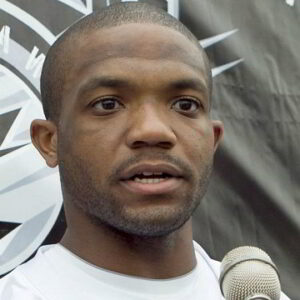
Maurice Edward Clarett is a former American football player who first rose to prominence during his high school career. In 2001, he earned Ohio’s prestigious Mr. Football Award and was also recognized as a High School All-American by USA Today. Despite his remarkable talent on the field, his early years were marked by off-field controversies, including time spent in juvenile detention. As a freshman at Ohio State University, Clarett played a key role in leading the Buckeyes to a national championship. He was selected by the Denver Broncos on the opening day of the 2005 NFL Draft, but the team released him before the regular season began. He later continued his professional career with the Omaha Nighthawks in the United Football League. Clarett’s football career was repeatedly overshadowed by legal troubles. He unsuccessfully challenged the NFL’s draft eligibility rules after being declared ineligible for the draft at an earlier stage. His off-field misconduct also resulted in his dismissal from Ohio State, multiple arrests, and prison sentences. After serving his time, Clarett rebuilt his life by becoming an entrepreneur and motivational public speaker.
Childhood & Early Football Career
Maurice Edward Clarett was born on October 29, 1983, in Youngstown, Ohio, United States, to Michelle Renee Clarett and Myke Clarett Sr. He grew up alongside his two brothers, Marcus A. Clarett and Michael Graham Clarett Jr.
Clarett showcased exceptional football talent from an early age. As a freshman, he played tailback for the varsity team at Austintown-Fitch High School before transferring to Warren G. Harding High School, where his outstanding performances earned nationwide recognition. By the time he completed high school, he had been ranked among the nation’s top 100 football prospects by several prominent publications.
In 2001, he was honored with Ohio’s prestigious Mr. Football Award, presented annually by The Associated Press (AP) to the state’s top high school football player. That same year, USA Today selected him as a High School All-American, further cementing his reputation as one of the country’s brightest young football stars.
His impressive high school career attracted scholarship offers from several leading college football programs, including the Notre Dame Fighting Irish, Miami Hurricanes, Fresno State Bulldogs, and Ohio State Buckeyes. After considering his options, Clarett verbally committed to Ohio State University and officially signed with the Ohio State Buckeyes in February 2002.
Football Career of Maurice Clarett
Maurice began his collegiate football career with the Ohio State Buckeyes and immediately made an impact. During his freshman season, he rushed for 1,237 yards, setting a school record for a first-year player. He also scored 18 rushing touchdowns, helping the Buckeyes capture the 2002 BCS National Championship.
On January 3, 2003, in the second overtime of the 2003 Tostitos Fiesta Bowl, Clarett scored the game-winning touchdown on a five-yard run against the Miami Hurricanes. With that performance, he became the first freshman since Ahman Green of the University of Nebraska-Lincoln in 1995 to lead a national championship-winning team in rushing.
Although he enjoyed tremendous success on the field, Clarett’s football career was soon overshadowed by personal struggles and disciplinary problems. Beginning in 2002, he battled alcoholism and depression, while also becoming involved in several controversies during his time at Ohio State. In December 2002, after publicly criticizing and confronting university officials, he was dismissed from the football program.
Following his departure from Ohio State, Clarett moved to Los Angeles, where he continued to struggle with substance abuse. During this period, he attempted to enter the 2004 NFL Draft by legally challenging the NFL’s rule requiring players to wait three years after graduating from high school before becoming draft-eligible. Although he initially won the case in a lower court, the ruling was overturned by the United States Court of Appeals for the Second Circuit. His subsequent appeal to the Supreme Court of the United States was declined.
Despite the setback, Clarett was eventually selected by the Denver Broncos on the opening day of the 2005 NFL Draft. He signed a four-year contract on July 28, 2005, but struggled during training camp and did not participate in preseason games. As a result, the Broncos released him on waivers on August 28, 2005, and no other NFL team offered him a contract.
Several years later, on August 30, 2010, Clarett signed with the Omaha Nighthawks of the United Football League. During the season, he rushed for 154 yards and scored one touchdown. His comeback was short-lived, however, as the United Football League ceased operations in 2012.
Legal Issues, Consequences & Life Thereafter
On January 1, 2006, authorities announced they were searching for Clarett in connection with two armed robberies that allegedly occurred outside the Opium Lounge nightclub in Columbus. Investigators accused him of using a .45-caliber handgun to rob two individuals before fleeing in a white SUV. The following day, he surrendered to police and was charged with two counts of aggravated robbery.
A grand jury formally indicted him on February 10, 2006. Clarett pleaded not guilty to the charges and was released on $20,000 bail while awaiting trial.
Before the robbery case was resolved, he was arrested again on August 9, 2006, after making an illegal U-turn in a sport utility vehicle he claimed belonged to his uncle. Police pursued him until his vehicle was stopped by a spike strip. During the search, officers discovered several weapons, including a loaded AK-47-style rifle.
On September 18, Clarett pleaded guilty to the charges against him. Judge David Fais sentenced him to seven and a half years in prison, although he became eligible to seek early release after serving a minimum of three and a half years.
While incarcerated at the Toledo Correctional Institution, Clarett enrolled in a distance education program through Ohio University, where he pursued a bachelor’s degree in Geriatrics and Gerontology.
During his imprisonment, he also authored a blog titled The Mind of Maurice Clarett, with posts uploaded online by his girlfriend. He devoted much of his time to improving his mental health while studying psychology and business literature.
Judge Fais granted Clarett an early release on April 7, 2010. As part of his release conditions, he was required to spend six months at Maryhaven, a Columbus-based addiction treatment center.
Following his release, Clarett worked to rebuild his life and became a respected motivational speaker, sharing his experiences at schools, juvenile detention centers, prisons, and community events.
In November 2012, he was invited to attend the tenth anniversary celebration of Ohio State’s undefeated 2002 national championship team. He later reconnected with the university, taking academic courses and mentoring current football players.
In August 2013, Clarett joined mental health advocates in supporting the expansion of Medicaid in Ohio. Later that year, he appeared in ESPN’s documentary Youngstown Boys, released in December 2013.
Ohio State University also invited him to participate in a ceremony honoring its national championship team. During the event, he addressed an audience of more than 500 people at the Archie Griffin Grand Ballroom, speaking candidly about his personal journey and redemption.
Personal Life of Maurice Clarett
In 2016, Maurice Clarett established The Red Zone, a behavioral health agency that has since expanded its operations with an office in Columbus, Ohio. Two years later, he launched the podcast Business and Biceps, where he discusses entrepreneurship, leadership, and personal development.
Clarett is also the father of a daughter named Jayden Clarett.