

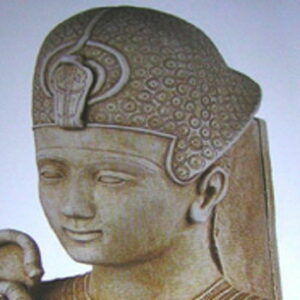
As the foundational figure of unified Egypt, Narmer stands as a pivotal bridge between the Naqada III period and the First Dynasty. Ruling around 3100 BC, he is widely celebrated for merging Upper and Lower Egypt into a single kingdom, a feat immortalized on the famous Narmer Palette, which depicts him wearing the distinct crowns of both regions.
Historical Identity and Reign
The First Unifier: Originally a king of Upper Egypt, Narmer expanded his reach to include Lower Egypt, though historians debate whether this occurred through military conquest or peaceful diplomacy.
The Menes Connection: Many scholars believe Narmer is the same individual as Menes, the legendary first pharaoh mentioned in ancient Egyptian chronicles and classical histories.
Lineage: He likely succeeded the Protodynastic rulers Ka or Scorpion II. While tradition often names Neithhotep as his queen and Hor-Aha as his son and successor, modern archaeological evidence suggests Neithhotep may have actually been Hor-Aha’s wife.
Legacy and Modern Culture
Narmer’s final resting place is a dual-chambered tomb located in the Umm el-Qa’ab necropolis near Abydos. Beyond his historical significance, his life has captured the modern imagination, serving as the inspiration for various works of historical fiction, such as Lincoln Child’s The Third Gate and Lester Picker’s The First Pharaoh.
Tracing the Identity & Family
The precise identity of Narmer has remained a central debate among scholars for decades. A majority of Egyptologists support the conclusion that Narmer and Pharaoh Menes are the same individual. According to historical records, Menes is credited as the first monarch of a unified Egypt; this aligns with the Narmer Palette, which portrays Narmer as the unifier wearing the distinct crowns of both Upper and Lower Egypt.
Archaeological evidence from two necropolis seals found at the Umm el-Qa’ab cemetery in Abydos further confirms Narmer as the inaugural ruler of the First Dynasty. While his reign is generally estimated to have begun around 3,100 BC, some researchers-using a combination of radiocarbon dating and historical analysis—propose a broader window between 3,273 and 2,987 BC.
Most historians identify his father as Ka, a Protodynastic ruler of Dynasty 0 who governed from Thinis during the early 32nd century BC. Ka is notable for being perhaps the first king to use the serekh symbol on artifacts. Another potential predecessor is Scorpion II, a ruler from the Naqada III period who may have governed during the transition between the reigns of Ka and Narmer.
The Narmer Palette
Unearthed in the late 19th century by James E. Quibell and Frederick W. Green, the Narmer Palette is a ceremonial siltstone slab standing roughly 2 feet tall. It features some of the world’s earliest hieroglyphic inscriptions. One side displays Narmer wearing both the white and red crowns, signifying his total dominion. His name is represented by symbols of a catfish (n’r) and a chisel (mr), often translated as “raging catfish,” though this interpretation is debated.
The reverse side depicts the king in a position of power, raising a war club to strike a captive enemy. A falcon representing the god Horus sits above the prisoner, symbolizing divine approval. Throughout these engravings, Narmer is shown in full royal regalia, including a ceremonial bull’s tail and a royal kilt, accompanied by a servant carrying his sandals.
History & Reign
During the Protodynastic era, Egypt was split into the urbanized, southern Upper Egypt and the fertile, rural northern Lower Egypt. As desertification forced tribes toward the Nile, Upper Egypt’s trade-driven wealth led its leaders to seek expansion. While earlier kings like Scorpion I and Ka made significant strides toward unification and established trade links as far as Canaan, Narmer’s influence was far more extensive.
His serekh has been identified at nineteen different sites across Lower Egypt and Canaan, suggesting he finalized the unification process that his predecessors began. While some suggest his successor Hor-Aha was the legendary “Menes,” the discovery of royal seals listing Narmer at the head of the First Dynasty strongly supports his status as the first human king of Egypt. Furthermore, evidence like the Narmer Macehead and various pottery shards indicates that his reign was a period of significant economic and military strength, with established Egyptian settlements in the Levant.
Neithhotep & Hor-Aha
Neithhotep was once mistaken for a male ruler due to the grandeur of her tomb and the presence of royal symbols. Once identified as a woman of high status, she was long thought to be Narmer’s queen-a marriage likely intended to solidify the union between Upper and Lower Egypt. However, inscriptions discovered in 2012 suggest she was actually the wife of his successor, Hor-Aha, and served as a regent for her son, Djer.
Tomb
Narmer’s final resting place, identified in 1964 as the B17 and B18 chambers in Abydos, consists of two mud-brick rooms. Located near the graves of his predecessors and successors, the site highlights Narmer’s unique position in history. While archaeology proves kings existed before him, ancient Egyptian tradition largely viewed Narmer as the starting point of their civilization, relegating earlier eras to the realm of myth.