

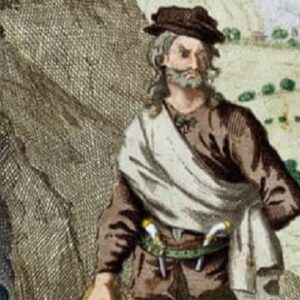
Sawney Bean is a figure widely associated with Scottish folklore. According to legend, he was a cannibal who survived by feeding on human flesh and served as the leader of a clan of cannibals. Bean was born into a farming family but developed a dislike for physical work from an early age. Preferring an effortless lifestyle, he rejected the hard labor expected of him. After marrying Agnes, a woman said to possess a similarly cruel nature, the couple was compelled to leave their hometown. They found refuge in a secluded cave, where they lived in complete secrecy, unnoticed by the outside world. To sustain themselves, they initially relied on robbery. However, to satisfy their hunger without drawing attention, Bean and his wife began killing travelers, consuming their victims, and stealing their belongings. Over time, they had numerous children, who later produced more offspring through incestuous relationships. As the family expanded, so did their need for food. The Bean clan adopted a systematic method of ambushing travelers, murdering them, and disposing of the bodies in ways that left little or no trace. Their secret remained hidden until one evening when they attacked a couple who fought back. The struggle attracted the attention of passing travelers, providing the first evidence that a gang of cannibals existed. In response, the king ordered an extensive search of the surrounding area, which eventually led to the discovery of the cave where the Bean family had been living. Every member of the clan was captured and put to death. Despite the enduring popularity of the story, many historians believe that Sawney Bean was a fictional character rather than a real historical figure. Nevertheless, he continues to be remembered as one of the most infamous personalities in Scottish legend.
Childhood & Early Life
Sawney Bean, whose birth name was Alexander Bean, is believed to have lived during either the 15th or 16th century, although the exact year and date of his birth remain unknown. Historical accounts and folklore differ regarding the precise period of his life. According to legend, he was born in East Lothian, Scotland.
Bean grew up in a farming family where manual labor was a way of life. His father earned a living by digging ditches and trimming hedges. Unlike the rest of his family, Bean disliked physical work from a young age and often refused to perform his duties. His unwillingness to work frequently resulted in punishment from his father. Known for his rebellious nature, Bean repeatedly ignored rules and expectations. His unsuccessful attempts to live an honest and hardworking life became a constant source of disappointment for his father.
Career of Sawney Bean
Sawney Bean’s life took a dramatic turn after he married Agnes Douglas, a woman who had a notorious reputation in the local community. According to popular tales, she was believed to be a witch associated with dark rituals, including human sacrifices and the summoning of evil spirits. Because of their feared reputation, the couple was forced to leave their hometown soon after their marriage.
They wandered throughout Scotland, surviving by robbing travelers. Over time, however, they realized that spending stolen goods to buy food could expose their crimes. To avoid suspicion, they began murdering their victims and consuming their bodies. This gruesome practice not only provided them with food but also eliminated evidence of their crimes. Some versions of the legend claim that Agnes introduced the idea of cannibalism, suggesting that she had practiced it even before meeting Bean.
After years of wandering, they eventually settled inside a large coastal cave at Bennane Head, located between Girvan and Ballantrae. The cave extended nearly 200 yards into the cliffs and contained numerous hidden tunnels and passageways. During high tide, the entrance became submerged, making it almost impossible for outsiders to discover their hiding place.
At first, the couple resorted to cannibalism only when they believed it was necessary. They carefully disposed of the remains of their victims in ways that made the deaths appear to have been caused by wild animals. As time passed, they also learned methods of preserving leftover body parts through pickling, allowing them to store food for later use.
The Bean family continued to grow over the years. Sawney Bean and Agnes had eight sons and six daughters, all of whom were raised to follow the same cannibalistic lifestyle. Their children were encouraged to have relationships with one another, resulting in numerous descendants born through incest. According to the legend, Bean eventually had 18 grandsons and 14 granddaughters.
Every member of the growing clan participated in the attacks. They hid in their cave during daylight hours and ventured out only at night to ambush unsuspecting travelers. After taking the victims back to the cave, they consumed the bodies and either preserved or discarded the remaining parts. Whenever body fragments washed ashore, residents assumed they were the remains of people killed by wild animals, allowing the clan to remain undiscovered for many years.
As the family became larger, they required more victims to sustain themselves. Their attacks became increasingly frequent, leading to a noticeable rise in the number of missing people across the region. Although residents organized search parties, none succeeded in locating the hidden cave. In the absence of evidence, several innocent people were wrongly accused and even attacked by suspicious townspeople.
The clan’s secrecy finally began to unravel after an attempted robbery involving a married couple returning home from a village fair on horseback. The attackers killed the woman, but her husband fought back fiercely. During the struggle, members of the clan reportedly began eating part of the woman’s body before escaping. Before they could kill the husband, several travelers arrived at the scene, forcing the Bean family to flee and abandon the bodies.
This incident provided the first convincing proof that a group of murderous cannibals existed in the area. In response, King James VI of Scotland ordered a large-scale search involving around 400 soldiers and several trained bloodhounds. After an extensive search, the dogs tracked the scent to the hidden cave, where the search party discovered a horrifying collection of human remains scattered throughout the cavern.
Death & Legacy of Sawney Bean
When the king’s men finally discovered the cave, Sawney Bean and the rest of his family surrendered without resisting. They were immediately arrested and executed without receiving a formal trial. According to the legend, the male members of the clan had their limbs severed and were left to die from blood loss, while the women were forced to witness the executions before being burned alive at the stake.
The stories claim that none of the captured family members expressed regret for their crimes. Bean’s alleged final words before his death were, “It isn’t over, it will never be over.”
Another local legend from Girvan tells of one of Bean’s daughters who supposedly left the clan before their capture and settled among the townspeople. She is said to have planted a tree known as the Dule Tree. After the Bean family’s crimes were uncovered, her identity became known, and the villagers reportedly hanged her from the same tree, which later earned the nickname “The Hairy Tree.”
Despite the widespread popularity of the story, no reliable historical evidence has been found to confirm that Sawney Bean or his clan actually existed. Many historians consider the tale to be nothing more than folklore, while others continue to believe that the events described in the legend may have been based on real occurrences.