
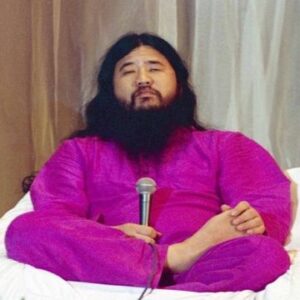
Shoko Asahara was born Chizuo Matsumoto in 1955 to a large, impoverished family in Kumamoto, Japan. Born with infantile glaucoma, he was blind in one eye and partially blind in the other, leading him to attend specialized schools for the visually impaired. After failing to enter medical school, he pivoted to traditional medicine, studying acupuncture and pharmacology. This career path ended in legal and financial ruin: in 1981, he was arrested and fined for practicing without a license and selling fraudulent medications, which led to the bankruptcy of his pharmacy.
The Birth of Aum Shinrikyo
In the mid-1980s, Asahara turned to spiritualism. He synthesized a wide variety of influences—including Taoism, esoteric Buddhism, Christianity, yoga, and meditation—into a new religious movement.
1984: He started a small yoga studio called “Aum Shinsen no Kai.”
1987: He rebranded the group as Aum Shinrikyo.
1989: Despite internal controversies, the group gained official legal status as a religious corporation from the Tokyo Metropolitan Government.
Asahara successfully marketed the group as a “religion for the elite,” attracting graduates from Japan’s top universities. He cultivated a divine persona, claiming to be the “Christ” and the “Lamb of God,” and utilized mass media and book publishing to grow his following to nearly 10,000 members in Japan and thousands more in Russia.
Radicalization and the Doomsday Prophecy
Asahara’s teachings eventually shifted toward a dark, apocalyptic vision. He prophesied a nuclear “Armageddon” and claimed that only his followers would survive. To facilitate this, the cult’s inner circle militarized, engaging in:
Weaponry: Stockpiling firearms and attempting to produce biological agents like botulinum toxin.
Chemical Warfare: Successfully manufacturing nerve agents, specifically VX and Sarin.
Political Ambition: After failing to win seats in the Japanese parliament, Asahara redirected the group toward overthrowing the government.
The Tokyo Subway Attack and Legal Reckoning
The cult’s violence peaked on March 20, 1995, when members released sarin gas on five trains across three lines of the Tokyo Metro during morning rush hour. The attack killed 13 people and injured thousands.
Arrest and Trial
Capture: Asahara was found hiding in a concealed room at the cult’s headquarters during a massive police raid in May 1995.
Charges: He faced 27 counts of murder across 13 indictments, including the 1989 murder of the Sakamoto family and a 1994 sarin attack in Matsumoto.
Sentencing: In 2004, after what was called the “trial of the century,” he was sentenced to death.
Execution
After years of appeals and delays—some due to his mental state and others due to the ongoing trials of his followers-Asahara was executed by hanging on July 6, 2018, at the Tokyo Detention House.