

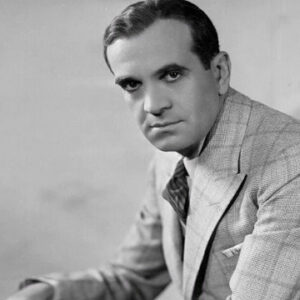
Al Jolson, born Asa Yoelson, was a celebrated American singer, comedian, and entertainer who was widely known as “The World’s Greatest Entertainer” at the height of his career. He began his journey as a stage performer before successfully transitioning into motion pictures. Jolson became a major attraction in New York’s musical theater scene, starring in numerous hit productions that earned widespread acclaim. He achieved lasting fame for his leading role in “The Jazz Singer,” the first feature-length film to successfully combine synchronized dialogue and music, marking a turning point in cinema history. Following its success, Jolson appeared in several other films and emerged as one of the defining performers of the early sound-film era. His energetic, dramatic, and larger-than-life stage presence helped distinguish him as one of Hollywood’s most recognizable entertainers. Beyond the silver screen, Jolson enjoyed remarkable success on Broadway and as the host of several popular radio programs. His immense popularity meant that many of his Broadway productions sold out rapidly, and during the early years of Hollywood, he ranked among the highest-paid performers in the film industry. Although his career experienced a temporary decline during his forties, he later enjoyed a successful comeback. During World War II, Jolson traveled overseas to perform for American troops, and his efforts to boost military morale were widely appreciated. Even after his passing, his musical comedies, vaudeville performances, and contributions to entertainment continued to influence audiences and remained highly regarded.
Childhood & Early Life
Al Jolson was born as Asa Yoelson on May 26, 1886, in Srednike, Lithuania, which was then part of the Russian Empire. He was the youngest of five children born to Moses Yoelson and Naomi Cantor. Raised in a Jewish family, Jolson’s father served as both a rabbi and cantor.
Seeking better opportunities, the Yoelson family immigrated to New York City in 1894. Tragically, Jolson’s mother died the following year, leaving him deeply affected by the loss. He later attended St. Mary’s Industrial School for Boys in Baltimore.
His introduction to the entertainment world came through Al Reeves, who encouraged his interest in performing. Jolson soon began entertaining audiences on the streets and developed a strong passion for theater. He often spent the money he earned attending performances at the National Theatre, further fueling his ambition to pursue a career on stage.
Career of Al Jolson
Jolson’s professional journey began in 1902 when he worked as an usher with Walter L. Main’s Circus. Before long, he became a singer for the circus and later joined the Dainty Duchess Burlesquers. After those productions ended, he teamed up with his brother Hirsch Yoelson, and together they performed in vaudeville shows through the William Morris Agency.
The brothers later joined forces with Joe Palmer and toured across the United States. As audiences showed limited interest in their performances, they adopted blackface stage makeup, a practice that was common in American entertainment at the time. The change proved successful and quickly became a defining feature of their act.
In 1906, Jolson launched a solo career at the Globe and Wigwam Theatre in San Francisco, where he gained recognition as a talented vocalist. Three years later, he returned to New York and joined Dockstader’s Minstrels as a featured performer.
His breakthrough came in 1911 when he starred in the musical comedy “La Belle Paree” at the Winter Garden Theatre. The production was a major success, running for more than one hundred performances and significantly boosting his popularity. He followed it with another successful musical, “Vera Violetta.”
Jolson’s years at the Winter Garden produced a string of triumphs. In 1916, he headlined “Robinson Crusoe Jr.” and later starred in “Sinbad.” The success of these productions established him as Broadway’s leading star.
His reputation grew even further with “Bombo” in 1921, a production that became closely associated with his name. A theater near Central Park was later named in his honor, reflecting his immense popularity. Around this time, he also became involved with the Century Theater in New York.
Jolson soon expanded into motion pictures. His most significant breakthrough came with “The Jazz Singer” (1927), produced by Warner Bros. The film revolutionized the movie industry by becoming the first feature-length production to successfully combine synchronized dialogue and music. Audiences were captivated by hearing a performer speak and sing on screen, and Jolson’s performance made him an international sensation.
His next major film, “The Singing Fool” (1928), surpassed even the success of The Jazz Singer and held box-office records for over a decade. He continued appearing in Warner Bros. productions such as “Say It with Songs,” “Mammy,” “Big Boy,” and “Show Girl in Hollywood.”
As public tastes evolved, Jolson returned to Broadway with “Wonder Bar,” though it failed to achieve the success he had hoped for. He regained critical attention in 1933 with the film “Hallelujah, I’m a Bum.”
He continued working in films for Warner Bros. until his contract ended in 1935, with “The Singing Kid” marking his final film for the studio. He later appeared in the Twentieth Century Fox production “Rose of Washington Square.”
In addition to his film work, Jolson remained highly active on radio. Throughout the 1930s and 1940s, he hosted and appeared on programs such as “Presenting Al Jolson,” “Shell Chateau,” and “Kraft Music Hall.”
During World War II, Jolson volunteered to entertain American troops overseas. With support from the United Services Organization (USO), he performed for soldiers stationed abroad, beginning at military bases in 1942 and later visiting numerous U.S. naval installations.
He also traveled to Korea during the Korean War, personally financing the trip. Over a period of sixteen days, he performed approximately forty shows for American servicemen. These efforts helped revive his popularity during the late 1940s.
Jolson’s remarkable life became the subject of the hit biographical film “The Jolson Story” (1946), one of the most successful movies of its era. Following its success, Decca Records signed him, and he continued recording music for the label. The sequel, “Jolson Sings Again,” also proved highly successful, and he remained with Decca until the end of his life.
Major Works of Al Jolson
Among Jolson’s many accomplishments, his most influential work remains “The Jazz Singer.” The film’s storyline closely reflected aspects of his own life and career. Its innovative use of synchronized speech and music transformed the motion picture industry and ushered in the era of talking films. The movie’s tremendous success elevated Jolson to superstar status and secured his place in entertainment history.
Family & Personal Life
Jolson’s first marriage was to Henrietta Keller, whom he married during the early years of his career. Their marriage lasted from 1907 to 1919, ending in divorce.
In 1922, he married Broadway performer Alma Osbourne, better known by her stage name Ethel Delmar. Their relationship ended in divorce in 1928.
Later that year, Jolson began a romance with renowned tap dancer Ruby Keeler. The couple married in September 1928 and adopted a son, Al Jolson Jr. Their marriage lasted until 1939, when they divorced.
In 1944, while performing in Arkansas, Jolson met Erle Galbraith, an X-ray technician. The two quickly developed a relationship and married in 1945. Together, they adopted two children, Asa Jr. and Alicia. Their marriage continued until Jolson’s death.
Death & Legacy
Al Jolson died of a heart attack on October 23, 1950, in his suite at the St. Francis Hotel in San Francisco. His recent trip to Korea had taken a toll on his health, and he was also suffering from complications related to a collapsed lung. More than 20,000 mourners attended his funeral, reflecting the enormous impact he had on American entertainment.
His contributions have been recognized through numerous posthumous honors. He was awarded three stars on the Hollywood Walk of Fame, received a Golden Palm Star in Palm Springs, California, and was inducted into the American Theater Hall of Fame.
Jolson’s influence has endured long after his passing. In 1994, the United States Postal Service honored him with a commemorative postage stamp. His recordings, films, and stage performances continue to be celebrated by fans and preserved through organizations such as the International Al Jolson Society, ensuring that his legacy remains alive for future generations.