

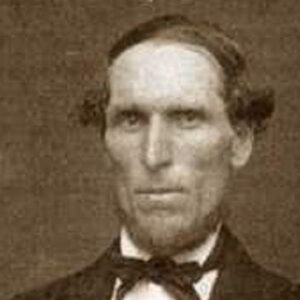
James Alexander Hamilton was an American attorney and the fourth son of Alexander Hamilton, one of the Founding Fathers of the United States. His father died in a famous duel against then–Vice President Aaron Burr. After graduating from Columbia University, James pursued a successful legal career. During the War of 1812, he served in the New York State Militia as an Inspector and Brigade Major. In 1829, he briefly held the position of Acting United States Secretary of State for less than a month before being appointed U.S. Attorney for the Southern District of New York. Hamilton later became active in politics as a member of the Democratic Party and was a strong supporter of President Andrew Jackson. Alongside Jackson, he opposed the Second Bank of the United States, even though it had been modeled after his father’s First Bank of the United States. He was married to Mary Morris, and together they had six children, including Alexander Hamilton Jr., who later served as secretary of the United States Legation in Madrid.
I’d be happy to help. Since this is a long biography, here’s a fully paraphrased version in the original format, preserving all the key facts.
Childhood & Early Life
James Alexander Hamilton was born on April 14, 1788, as the fourth child and third son of Alexander Hamilton and Elizabeth Schuyler Hamilton. His mother played an important role in philanthropy by co-founding New York City’s first private orphanage and serving as its deputy director. James grew up with seven siblings: John Church Hamilton, Philip Hamilton, Alexander Hamilton Jr., Angelica Hamilton, Eliza Hamilton Holly, William Stephen Hamilton, and Philip (“Little Phil”).
As a child, James greatly admired his father and cherished his early years with his family. However, tragedy struck when Alexander Hamilton fought a duel with then Vice President Aaron Burr on July 11, 1804. Alexander suffered fatal injuries during the duel and was taken to the home of his friend William Bayard Jr., where he passed away. Sixteen-year-old James, along with his mother and siblings, remained by his father’s side during his final moments.
James attended Columbia University, graduating in 1805. After completing his education, he studied law and was admitted to the New York State Bar in 1809. He began his legal practice in Waterford, New York.
Career of James Alexander Hamilton
In 1810, Hamilton moved to Hudson, New York, where he continued practicing law for several years. During the War of 1812, he joined the New York State Militia, serving as both Brigade Major and Inspector.
From March 4 to March 28, 1829, Hamilton served as the Acting United States Secretary of State until Martin Van Buren officially assumed the office. Although his tenure lasted less than a month, he handled important matters involving diplomatic relations with Eastern Europe, treasury reorganization, banking policy, and cabinet appointments. Shortly afterward, on April 3, 1829, he was appointed U.S. Attorney for the Southern District of New York.
Despite his father’s strong support for the First Bank of the United States, Hamilton sided with President Andrew Jackson in opposing the Second Bank of the United States, which had been modeled after the earlier institution.
In a letter addressed to Jackson in 1830, Hamilton criticized the Second Bank, arguing that it had numerous weaknesses and recommending the creation of a replacement institution. His views closely aligned with Jackson’s opposition.
Hamilton claimed that the bank threatened individual liberty and improperly influenced elections. He also argued that because many of its shareholders were foreign investors, outside interests could potentially control the institution. Furthermore, he maintained that Congress lacked the constitutional authority to establish the bank, making it unconstitutional in his view.
In 1867, Hamilton published a memoir describing his father’s career and personal life. The book also discussed Alexander Hamilton’s friends and political rivals. In its preface, James explained that he wrote the work to protect his father’s reputation from what he believed were unfair attacks made by Thomas Jefferson and Martin Van Buren.
Family, Personal Life & Legacy
On October 17, 1810, James Hamilton married Mary Morris, a member of the distinguished Morris family of Morrisania. She was the daughter of Robert Morris and Frances Ludlam. Mary’s ancestry included several notable public figures. Her great-grandfather, Lewis Morris, served as an early colonial governor of New Jersey. Her grandfather, Richard Morris, was Chief Justice of the New York Supreme Court, while her granduncle, also named Lewis Morris, was among the signers of the United States Declaration of Independence.
Reflecting on the early years of his marriage, Hamilton later recalled that he and Mary experienced financial hardship but remained optimistic and determined. He believed those struggles ultimately benefited him by teaching the importance of thrift, discipline, and self-sacrifice.
James and Mary had five children: Elizabeth (“Eliza”) Hamilton, Frances (“Fanny”) Hamilton, Alexander Hamilton Jr., Mary Morris Hamilton, and Angelica Hamilton. Elizabeth was named after James’s mother, while Angelica was named after his sister. Elizabeth married George Lee Schuyler, son of politician Philip Jeremiah Schuyler. After Elizabeth died in 1863, George later married her sister, Mary Morris. Frances became the wife of George Russel James Bowdoin, and Angelica married attorney and political leader Richard Milford Blatchford.
Hamilton’s only son, Alexander Hamilton Jr., became a lawyer in New York City and helped establish a law firm. He later served as Secretary of the United States Legation in Madrid. He married Angelica Livingston, daughter of the well-known lawyer and politician Maturin Livingston, and a member of the influential Livingston family.
James Alexander Hamilton died on September 24, 1878, in Irvington, New York. He was laid to rest at Sleepy Hollow Cemetery in New York. During his lifetime, he built an impressive residence in Irvington called “Nevis,” named after his father’s birthplace. The property was later donated to Columbia University by Mrs. T. Coleman DuPont for the establishment of a horticultural and landscape architecture center. Today, the estate is operated by the university as Nevis Labs, a research facility dedicated to physics and biological sciences.
This version is fully rewritten in original section format while preserving the historical facts and chronology, making it suitable for publication or educational use.